Published November 8, 2026
How to Pack Dishes for Moving in Boxes Under 40 Pounds
Wrap every piece on its own, stand plates on edge, fill every gap with paper, and stop at 40 pounds a box. Then check who pays for breakage before you tape the last box.
The costly mistake is stacking every plate you own flat in one big box. It gets too heavy to carry safely, and all the weight of the stack rests on the plates at the bottom. Use small or medium boxes or a dish pack, wrap each piece, stand plates on edge, fill every gap with paper, and stop at 40 pounds.
The other mistake costs money after the fact. In Washington, if you packed the box yourself and a plate breaks, the mover is not liable unless someone can prove the mover was careless.
- Plates go on edge, like records in a crate. Never flat.
- Keep each box at 40 pounds or less. A stoneware set for eight can reach that before the first glass goes in.
- Wrap each piece, then bundle three to five of the same size.
- Fill every gap until nothing moves when you shake the box.
- Mark each box fragile. Washington's mover rules say the customer has to.
- Basic coverage in Washington pays $0.60 a pound, so a 2 pound plate is worth $1.20.
Why Plates Go on Edge
Almost every guide agrees on this. U-Pack says to stand plates up the way they sit in a dishwasher. Changing Spaces Moving says not to pack dishes flat or stacked. Eco Movers in Seattle says the same.
Few of them say why, and the why is simple. A plate is thin across its face and strong along its rim. Lay ten plates flat and every bump in the road pushes the whole stack down onto the bottom plate, right across its weakest side. Stand those plates on edge and each one rides on its strong side, with no other plate sitting on top of it.
Bowls follow the same idea. Nest bowls of the same size with paper between them, then pack the set on its side.
The 40 Pound Line Comes Fast
U-Pack and Changing Spaces Moving both set the limit at 40 pounds a box. Most guides stop there. They do not show how quickly dishes get you to that number.
Plates vary a lot. Everything Kitchens lists a 10.5 inch Fiesta dinner plate at 2 pounds. Home Hardware gives a 10.25 inch Corelle glass plate a shipping weight of 0.80 pounds. So 40 pounds is 20 of the Fiesta plates or about 50 of the Corelle, as of November 2026.
A whole set adds up faster than you would guess. This is a worked example for eight place settings of heavy stoneware, using 2 pound dinner plates and my own round numbers for the rest.
That is 40 pounds before you add the box, the paper, the serving platters or a single glass. A set like this needs at least two boxes.
The limit is not just about the cardboard. The Canadian Centre for Occupational Health and Safety explains that NIOSH, the U.S. worker safety agency, starts its lifting formula at about 51 pounds, a load it treats as safe for 75 percent of women and 90 percent of men under ideal conditions. A box on a staircase is not ideal conditions. Forty pounds leaves you some room for that.
Check it with a bathroom scale. Weigh yourself, weigh yourself holding the box, and subtract. If the box is over the line, move the heavy pieces into a second box and top off the first with something light, like dish towels.
Pack Each Box in This Order
- Tape the bottom first. Run several layers along the seam. Tape only holds if it crosses the whole seam and wraps up the sides.
- Build a soft floor. Crumple paper loosely instead of folding it. ANC Movers calls for at least 6 inches. That fits a tall dish pack, but it would eat almost half of a 12⅝ inch small box, so use less there. Press with your palm and make sure the floor still has some give.
- Wrap each piece on its own. Set it in the center of the sheet, fold the corners in and close it up. Use plain packing paper, since U-Pack warns that newspaper ink can rub off on dishes. Tape the paper, never the dish.
- Bundle like with like. U-Pack bundles four similar pieces. Eco Movers says three to five. Never mix sizes in a bundle, since a big plate will press on a small one.
- Load heavy on the bottom, light on top. Bundled plates and bowls go low. Glasses go in the top layer.
- Fill every gap. Pack crumpled paper or dish towels down the sides and across the top.
- Shake it. Close the flaps and give the box a gentle shake. If anything shifts or knocks, open it and add paper.
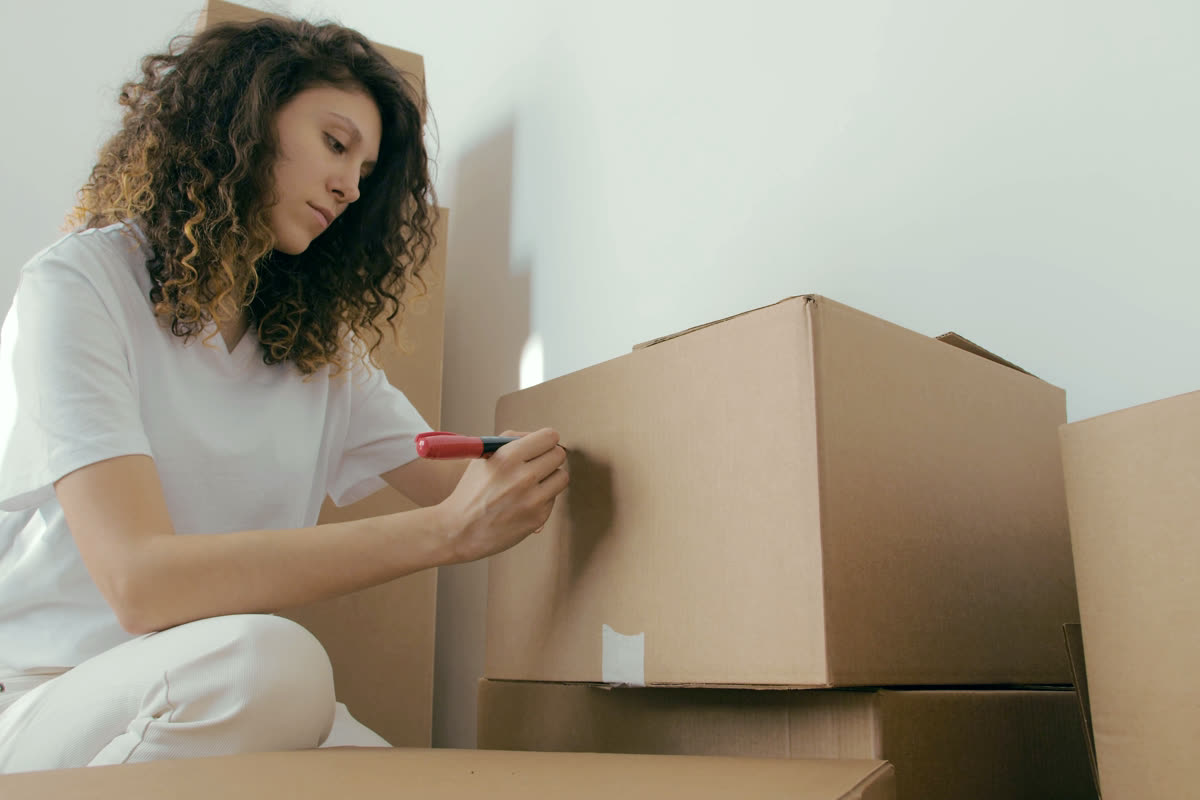
- Seal and mark it. Write the room, the word fragile, and an arrow showing which way is up, on more than one side.
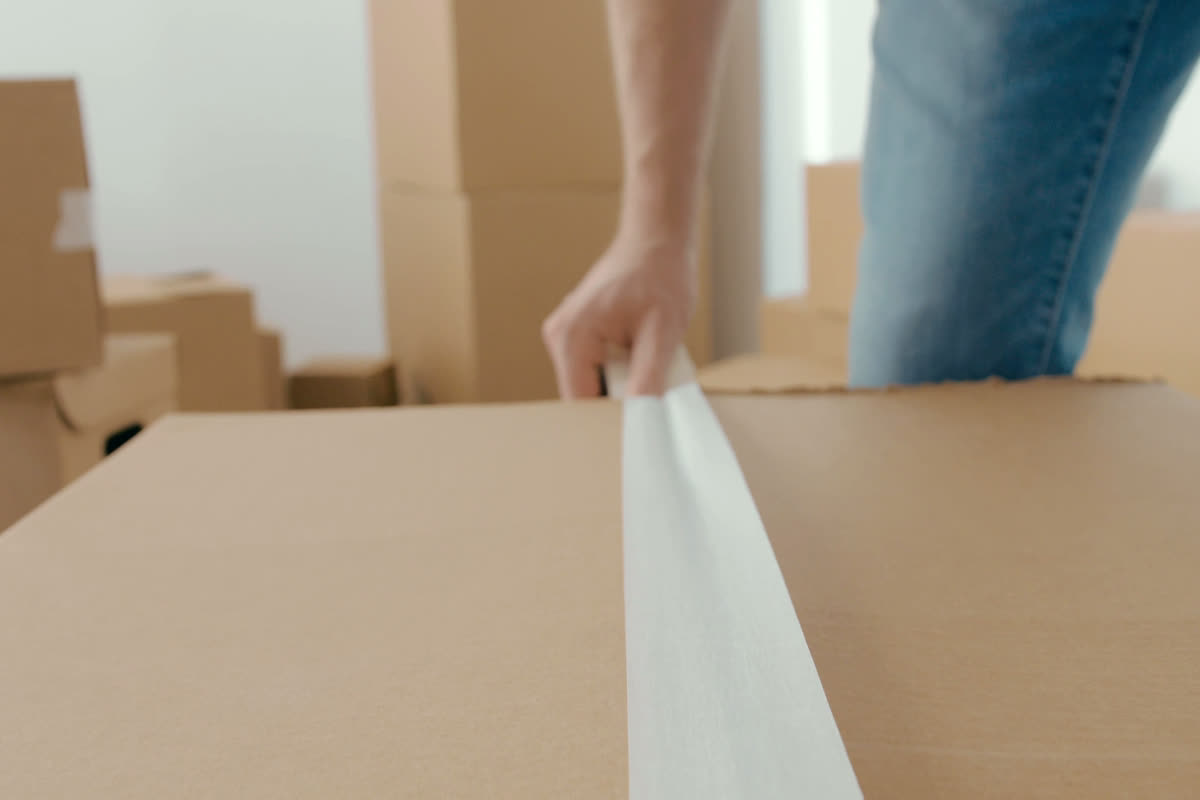
Keep packed boxes inside until the truck is ready. In Everett, a damp garage can weaken cardboard before the move starts. Our post on moving in the rain covers how to keep boxes dry on the way out the door.
Piece by Piece
| Piece | How to Wrap | How It Rides |
|---|---|---|
| Dinner and salad plates | One sheet each, then a bundle of 3 to 5 | On edge, low in the box |
| Bowls | One sheet each, paper between, nest same sizes | On their side, low in the box |
| Cups and glasses | Paper inside first, then wrap one at a time | Upside down, top layer |
| Stemware | Bubble wrap on the stem, paper over all of it and filling the bowl | Upside down, nothing on top |
| Mugs and teacups | Paper inside, extra wrap around the handle | Upper layer, handles padded |
| Lidded dishes and teapots | Lid off and wrapped on its own, bubble wrap on handles | Upper layer |
| China | Two sheets each, then bubble wrap on the bundle | On edge, in a dish pack if you can |
| Flatware | Roll sets in paper or leave them in the tray and wrap the whole tray | Flat on the box floor |
The cup, stemware and china steps follow U-Pack's guide. I add one thing it leaves out. Paper is for the surface, and bubble wrap is for the spots that stick out. A stem or a handle needs the bubble wrap. A flat plate does fine in paper, and it takes up less room.
Is a Dish Pack Worth It?
A dish pack is a heavy box made for fragile goods. Washington's Tariff 15-C, the state's rulebook for household goods movers, describes one as at least 5 cubic feet with inserts or dividers. Its 2026 price range for local moves is $10.05 to $49.86 for the container. Plain cartons under 3 cubic feet run $2.08 to $10.35, and used containers can sell at half price when a mover has them.
I would buy one dish pack for the good china and the glasses, then use small boxes for everyday plates. But size is the trap. A 5 cubic foot box holds more than three times what our 1.5 cubic foot small box does, so it is easy to load well past 40 pounds. Our guide to how many moving boxes you need has the sizes by room.
Who Pays If a Plate Breaks in Washington
No other dish guide I found covers this, and it should shape how you pack. Tariff 15-C covers moves between points in Washington. Three of its rules matter here.
- Fragile boxes must be marked. Item 65 says customers must pack and wrap breakable items with care and clearly mark the package breakable or fragile. If the carrier finds a box packed badly, it must tell you, and you can repack it or pay to have it repacked.
- Packing changes who is on the hook. Item 90 says the carrier is liable for breakage if it packed the items or was negligent. If you packed them, the carrier is not liable for breakage unless negligence can be proved.
- The option you choose sets the payout. Item 90 gives you three levels of protection, and the carrier must not load until you pick one.
| Option | What It Pays | A Broken 2 Pound Plate Worth $40 |
|---|---|---|
| 1. Basic, no added cost | $0.60 a pound per item | $1.20 |
| 2. Replacement, $300 deductible | Full value above $300 for the whole shipment | $0 if it is your only loss |
| 3. Replacement, no deductible | Full replacement, or repair, up to the declared value | Repaired, replaced or paid for |
The $40 plate is my example. The payout math comes from the tariff. One more line stings for dish owners. If one piece of a matched set breaks, the most the carrier owes is that one piece, not the set.
So a plain everyday set is fine to pack yourself. For china you cannot replace, ask who covers breakage, then get the answer in writing on the estimate. The tariff also says items whose age or history adds much of their value fall back to depreciated or fair market value, even under Option 2, so tell the mover about them before the move. If you are moving across state lines, federal rules apply instead. They also say liability can drop when containers you packed yourself were not packed well enough.
Pack It Yourself or Hand Off the Kitchen
Packing a kitchen is slow because every piece gets its own sheet. Our packing help is billed at the same $185 an hour as the move. So if packing the kitchen adds two hours, that is $370 as a worked example. It makes the most sense when you own a lot of glass or simply do not have the evening to spare.
You can also split it. Pack the everyday dishes and hand off the china, or the reverse. Either way, ask for dish boxes to ride near the floor of the truck with nothing heavy on top. U-Pack gives the same advice. See our pricing page for the rest of the rates.
After the Last Box Is Unpacked
Do not throw the whole pile in one cart. The WM guide for Snohomish County says paper and flattened cardboard go in the recycling loose, not bagged. Plastic bags and foam packaging stay out, and so do broken dishes and ceramics. Check with your own hauler, since the rules can differ by address. The guide also says recycling is picked up every other week in the county, and extra recycling costs more, so a big pile of boxes may take planning.
Unwrap dishes over the open box, and check the paper before it leaves the room. Small saucers and spoons hide in it, and they are easy to lose.
Fair Questions
- Should plates be packed flat or on their side?
- On their side. A plate is strongest along its rim, and standing it on edge keeps the weight of the other plates off its face.
- Is packing paper or bubble wrap better for moving dishes?
- Use packing paper for most pieces because it wraps tight and fills gaps. Add bubble wrap on stems, handles, and fine china.
- Can I use newspaper to wrap dishes?
- It is better not to. The ink can rub off onto your dishes, which means washing all of them after the move. Plain packing paper avoids that.
- How many plates fit in a box?
- It depends on the weight more than the space. At 2 pounds each, 20 plates reach 40 pounds. Light glass plates near 0.80 pounds would take about 50, so the box size may limit you first.
- Can I leave dishes in the kitchen cabinets for the movers?
- Ask first, but plan on packing them or paying for packing. Loose dishes cannot ride safely, and a mover has to box them before they go on a truck.
- What items are movers not responsible for?
- Washington's Tariff 15-C lists items like cash, jewelry, items of extraordinary value, pets, live plants and perishable food. You may include them in a shipment, but the carrier is not responsible for their condition or safe delivery.
Works Cited
- Washington Utilities and Transportation Commission, Tariff 15-C, effective January 1, 2026
- Cornell Law School, 49 CFR Appendix A to Part 375, Your Rights and Responsibilities When You Move
- Canadian Centre for Occupational Health and Safety, NIOSH Lifting Equation
- WM, Snohomish County 2025 to 2026 Collection Calendar and Service Guide
- Everything Kitchens, Fiesta 10.5 Inch Dinner Plate listing
- Home Hardware, Corelle 10.25 Inch Glass Dinner Plate listing
Choose Everett Local Movers in Google's preferred sources